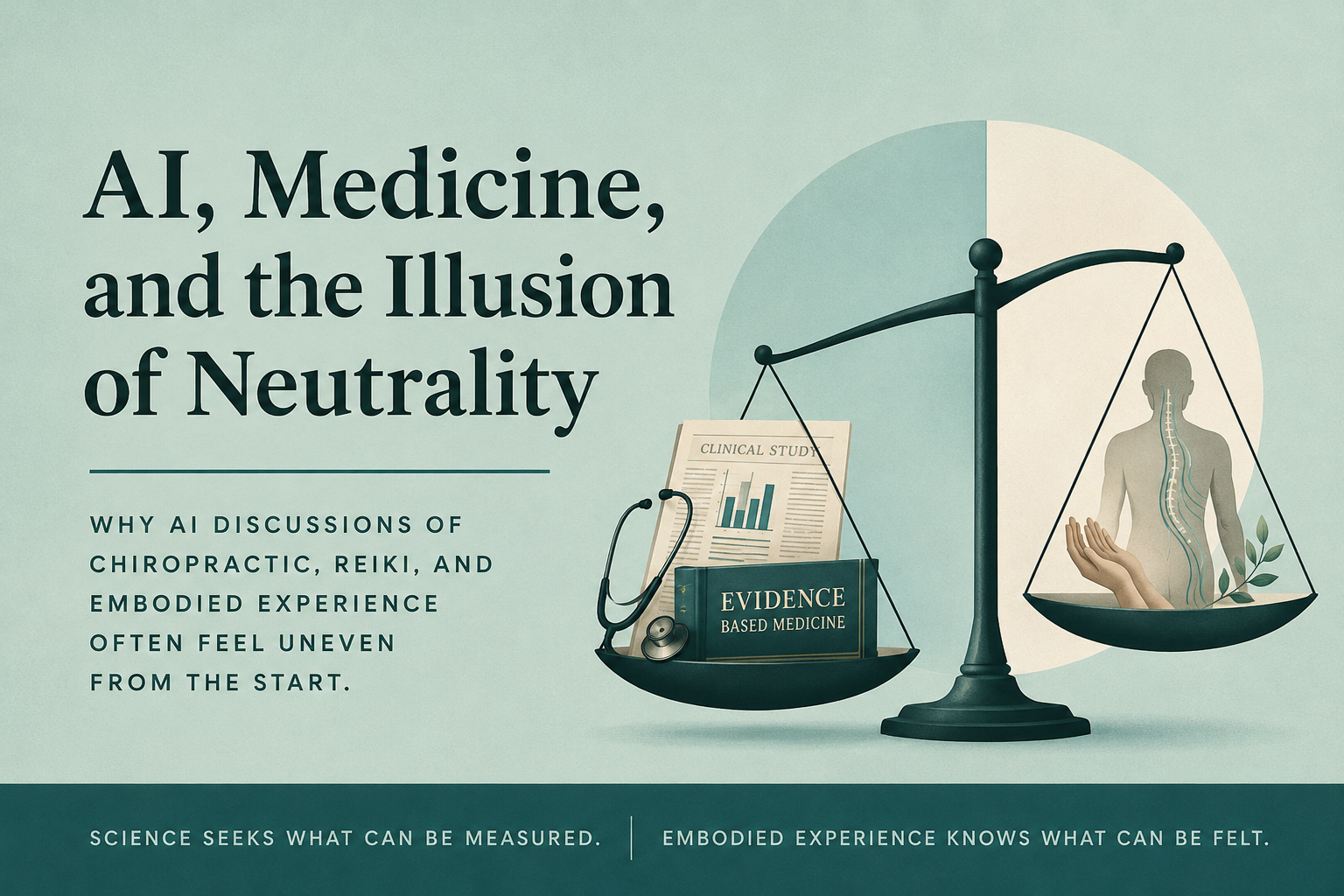
AI, Framing, and the Illusion of Neutrality
Many people turn to AI as a sounding board because it seems detached, informed, and capable of considering many sides of a question. In some ways, that can be true. AI can summarize, compare, organize, and explain across a wide range of subjects.
But AI is not a blank mirror. It is shaped by the material it was trained on, the institutions most represented in that material, the safety systems placed around it, and the assumptions built into how answers are judged as responsible or reliable.
The result is not necessarily intentional bias. It is often something quieter: a built-in tendency to speak more confidently from dominant frameworks, while treating less dominant frameworks as claims, beliefs, reports, or interpretations.
The Power of Framing
Framing matters because it shapes how a subject is understood before any specific conclusion is reached.
A response can appear balanced while still giving one framework the position of authority and another the position of explanation, exception, or personal experience.
For example, mainstream medical explanations may be presented in direct language: a treatment works, a condition is caused by something, or a mechanism is understood in a particular way.
Other frameworks may be introduced with more distance: practitioners believe, patients report, advocates claim, or traditions hold that something is true.
Those words are not neutral. They tell the reader which ideas are being treated as knowledge and which are being treated as belief.
Evidence, Authority, and Tone
Modern AI systems tend to privilege established evidence hierarchies. This is especially visible in subjects connected to health, science, risk, and public safety.
That tendency has understandable reasons. Evidence, measurement, peer review, and institutional accountability matter. Without them, answers can become careless or misleading.
But the same tendency can also flatten subjects that do not fit neatly into conventional categories of proof.
This can happen in discussions of chiropractic, Reiki, acupuncture, meditation, chronic pain, psychotherapy, nutrition, disability experience, indigenous knowledge, bodywork, and other areas where lived experience, practice-based knowledge, and institutional evidence may not line up neatly.
In those areas, AI may not simply explain. It may translate the topic into the language of the dominant framework, even when the user is asking to understand the topic on its own terms.
Concrete Examples
Chiropractic and Reiki are useful examples because they show how quickly AI language can shift.
A chiropractic question about spinal adjustments may be answered primarily in terms of gas bubbles, temporary relief, placebo-compatible effects, or neurological modulation. Those explanations may have value, but they may not fully engage with how chiropractors themselves understand their work.
Within chiropractic, practitioners may speak about restricted motion, joint fixation, alignment, compensatory strain, posture, muscle tone, and the body as an interconnected mechanical system.
Similarly, Reiki may be discussed by AI mainly through relaxation, stress reduction, expectation, or placebo-compatible models. Those may be relevant from one perspective, but they do not fully capture how Reiki practitioners or recipients may understand the experience.
The same pattern can appear far beyond these two examples. A person describing chronic pain may have their lived experience translated into risk factors and probabilities. A person discussing meditation may receive a neuroscience explanation when they were asking about contemplative practice. A person asking about nutrition may receive population-level guidance when they were exploring individual response.
Different Ways of Knowing
There is a deeper philosophical issue beneath this.
Some forms of knowledge are external, measurable, and reproducible. They rely on instruments, studies, statistics, and independent verification.
Other forms of knowledge are experiential, relational, interpretive, or practice-based. They may come from repeated observation, skilled hands, bodily awareness, personal history, cultural tradition, or direct experience.
These ways of knowing are not identical. They do not always answer the same questions. They do not always use the same standards. And they do not always translate cleanly into each other.
AI often handles this tension by leaning toward the form of knowledge that is easiest to defend within institutional and statistical terms.
That may make the answer safer. It may also make the answer narrower.
Language Reveals the Hierarchy
The hierarchy often appears in small word choices:
- “works” versus “is believed to work”
- “treats” versus “claims to treat”
- “shows” versus “suggests”
- “knowledge” versus “belief”
- “evidence” versus “anecdote”
- “objective” versus “subjective”
Each word may be defensible in isolation. But repeated over time, these choices create a pattern. One side is allowed to sound solid. The other is made to sound provisional.
This matters because users often come to AI not only for facts, but also for help thinking. If the thinking space is already tilted, the user may feel guided toward a conclusion before the conversation has truly opened.
The Limits of AI as a Sounding Board
AI can be useful as a sounding board, but it is not a neutral consciousness standing outside culture, science, medicine, technology, or institutional power.
It inherits patterns. It ranks credibility. It has default assumptions about what kinds of knowledge deserve direct language and what kinds require distancing.
That does not make AI useless. It means the user needs to notice the frame.
A good answer is not only accurate within a dominant system. It should also be clear about which system it is speaking from, and when it is translating one framework into another.
AI may be most useful when it does not pretend to be viewless.
Its value lies not in perfect neutrality, but in making its frames visible: what it is prioritizing, what it is minimizing, what language it is choosing, and which assumptions are already present before the answer begins.
Once the frame is visible, the conversation becomes more honest.
This reflection emerged from an extended conversation between rklen and AI itself, 2026.